The exhibition “ Istanbul International New Year Exhibition ” by Ceren Aktaş was presented at Nidra Art Project & Sanatif Yaklaşımlar in Istanbul,Türkiye from December 26,2025 to January 4, 2026.
Between Symmetry and Dream, She Remains Unspoken
Ceren Aktaş does not just paint the portraits , she builds a whole different visual world around them. Her work at Sanatif Gallery for the Istanbul International New Year Exhibition sits in a fascinating tension , intimate yet fancy , controlled yet rebel. It does not hit you all suddenly , it opens up slowly just like a good painting should be. In her figures , there is something like Egon Schiele’s psychologically loaded faces and from Henri Matisse’s confident , elegant line whereas Ceren makes it totally her own style. Her figure feels carefully constructed and somehow unresolved which makes them compulsive.
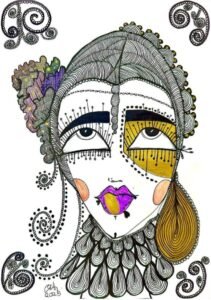
The face , at first look , seems calm and classically balanced. Look longer and a quiet asymmetry reveals itself which feels entirely intentional. It gets more interesting in the eyes , rather than working together , they seem to consist in seperate worlds. One is full of fine , almost electric lines , like something is transmitted outward. The other one sists inside a thick field of yellow which makes it to feel have a private interior.
Aktaş’s vision is never simple or unified. It’s fractured and built in layers that touches something very real about how we understand both perception and identity today.
If there is one tool Aktaş trusts above all others , it’s line. It’s neither line as outline nor line as description, but line as something that thinks. It repeats, folds back on itself, reaches outward, so it’s not just a face but an entire ornamental world around it. You can feel the pull of historical decorative traditions and something of contemporary graphic art too. The love of pattern and surface richness make Klimt comes to mind and where Klimt often lets ornament luxuriate , Aktaş keeps it significant. The spirals, the layered patterns and the flowing hair are not just there to beautify the figure, they are there to construct it. The ornament , in her hands, becomes something closer to architectonics.
Aktaş love the lines and feels most at home. It’s not just something she uses to outline or describe , it is where the work actually begins. Through repetition , folding and extension , her lines do not simply trace the edges of a face, they build an entire world around it which pulls from centuries of decorative tradition while feeling completely of the moment. You sense a similarity with Gustav Klimt in places , but Aktaş chasing that kind of ornamentation. Her spirals , patterns, the way hair moves through her compositions none of its decoration layered on top of the figure. The ornament does not beautify the structure , it becomes the structure.
Color does not show up often here , and that is exactly what makes it
hit so hard when it does. The lips split between a deep purple and a sharp central yellow feel almost like a crack running through. The soft blush on the cheeks delicate, more familiar but something about it feels slightly off like a flourish to traditional portraiture, which quietly denies to play by its rules. That push and pull between what feels definable and what feels undecided is what gives the work its edge.
This reminds to mind artists like Tracey Emin , that same sense of intimacy that does not quite let you get comfortable, where closeness and disintegration exist in the same breath.
Below the face, a necklacelike sequence of teardrop forms extends outward in rhythmic repetition. Each unit echoes the next, yet retains slight variation. This interplay between uniformity and difference introduces a quiet but persistent tension identity as both pattern and exception. It is here that Aktaş’ s compositional intelligence becomes most evident repetition is never static, it pulses.
You can see the clean lines , confident execution in her illustration background in the work but Aktaş is not content to stop there. She takes that skills and pushes them to a more conceptual area. The figure is not beautified or idealized. It has built , piece by piece , through the marks and symbols and willful deductions. The identity in her world , isn’t something solid or fitted. It’s always something that keeps forming.
Her illustration roots show the clean confident line , but Aktaş is not just simply applying those skills, she is also redirecting them. The figure in front of you is not styled or made beautiful in any traditional sense. It’s combined through marks , symbols, small disruptions. The identity here isn’t something you arrive at , its something in the process of becoming.
In an exhibition full of work competing for your attention , Aktaş’s work do something different. It waits , there is no immediate grab , no visual shout. Spending a few minutes with the work and something opens up. That quality feels rare in an international exhibition context and truly valuable. It’s the kind of work that would sit comfortably in the London art scene , where quiet confidence and notional depth tend to be respected more than appearance. There is even a tentative echo of David Hockney in her artwork , not in the style but in that same quality of surface serene concealing.
What Aktaş leaves you with is a new way of thinking about ornamentation. It’s not decoration , not trimming , it’s the structure and it’s meaning. The face becomes a starting point, from there the identity spills outward into rhythm, iteration, pattern. The portrait she builds is a strange and appealing thing , it’s close and distant at the same time. It stays with you and it stays precisely because it resists being fully grasped.